Enlarging the European Union: The Experience of Bulgaria and Romania, 20 Years On
WP_Post Object
(
    [ID] => 12702
    [post_author] => 18
    [post_date] => 2026-10-14 14:12:49
    [post_date_gmt] => 2026-10-14 12:12:49
    [post_content] => On Monday 23 November 2026, the Foundation is organizing a dialogue in partnership with the Pierre du Bois Foundation on the enlargement of the European Union.

On 1 January 2007, Bulgaria and Romania joined the European Union. Nearly twenty years later, what remains of the hopes, fears, and promises of that accession? What benefits have they reaped, what challenges remain, and what does this experience teach us at a time when new enlargements are on the European agenda?

To discuss these issues, the Pierre du Bois Foundation and the Jean Monnet Foundation for Europe are bringing together four prominent figures from Bulgaria and Romania with complementary backgrounds:
Ana-Maria Bercu
Professor, Faculty of Economics and Business Administration, Alexandru Ioan Cuza University of Iași, Romania
Stella GhervasProfessor of International History and Politics, Pierre du Bois Chair Europe and the World, Geneva Graduate Institute
Gergana Passy
President of PanEuropa Bulgaria, former Minister of European Affairs of Bulgaria
Sandra Pralong
President of the SynergEtica Foundation, former State Advisor and member of the Cabinet of the President of Romania
Practical informations:
The event will be hosted by GillesGrin, director of the Jean Monnet Foundation. It will be conducted in English with simultaneous English-French translation available on site.
Program:
18:00-20:00: dialogue and Q&A with the audience
20:00-20:30: public aperitif
Follow the livestream:
[post_title] => Enlarging the European Union: The Experience of Bulgaria and Romania, 20 Years On
[post_excerpt] =>
[post_status] => publish
[comment_status] => closed
[ping_status] => closed
[post_password] =>
[post_name] => enlarging-the-european-union-the-experience-of-bulgaria-and-romania-20-years-on
[to_ping] =>
[pinged] =>
[post_modified] => 2026-10-15 14:23:39
[post_modified_gmt] => 2026-10-15 12:23:39
[post_content_filtered] =>
[post_parent] => 0
[guid] => https://jean-monnet.ch/?post_type=evenement&p=12702
[menu_order] => 0
[post_type] => evenement
[post_mime_type] =>
[comment_count] => 0
[filter] => raw
)
On Monday 23 November 2026, the Foundation is organizing a dialogue in partnership with the Pierre du Bois Foundation on the enlargement of the European Union.
43nd issue of the Debates and Documents Collection
WP_Post Object
(
    [ID] => 12648
    [post_author] => 18
    [post_date] => 2026-10-05 09:03:59
    [post_date_gmt] => 2026-10-05 07:03:59
    [post_content] => The Foundation is pleased to announce the publication of the latest issue of its Debates and Documents Collection (issue 43), available in open access.

This issue, entitled "The Future of Democracy in Europe and the Future of Ukraine", contains the text of the speech delivered on 29 June 2026 in Lausanne by Dr Pat Cox, former President of our Foundation and the European Parliament, during the dialogue organised by the Jean Monnet Foundation for Europe on the future of Europe and Ukraine. He analyses the worldwide decline of liberal democracy, the weakening of American leadership and the threats facing the European information space. He examines the war in Ukraine and the challenges of its accession to the European Union. He argues for a determined defence of European democratic values on two fronts: against internal erosion and against external manipulation.

Read or download the publication

Read or download the publication for ereader


    [post_title] => 43nd issue of the Debates and Documents Collection
    [post_excerpt] =>
    [post_status] => publish
    [comment_status] => closed
    [ping_status] => closed
    [post_password] =>
    [post_name] => 12648
    [to_ping] =>
    [pinged] =>
    [post_modified] => 2026-10-06 10:30:40
    [post_modified_gmt] => 2026-10-06 08:30:40
    [post_content_filtered] =>
    [post_parent] => 0
    [guid] => https://jean-monnet.ch/?post_type=publication&p=12648
    [menu_order] => 0
    [post_type] => publication
    [post_mime_type] =>
    [comment_count] => 0
    [filter] => raw
)
The Foundation is pleased to announce the publication of the latest issue of its Debates and Documents Collection (issue 43), available in open access.
WP_Post Object
(
    [ID] => 12610
    [post_author] => 18
    [post_date] => 2026-08-31 14:08:51
    [post_date_gmt] => 2026-08-31 12:08:51
    [post_content] => The Foundation is delighted to announce the publication of the 221th "Red Book", historic collection founded in 1957 by Professor Henri Rieben. This publication is in open access.

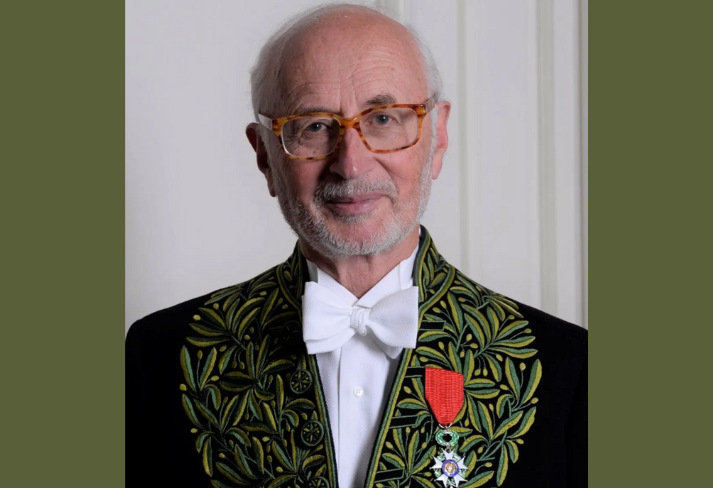
The author, Gilles Grin, who holds a PhD in international relations and is a corresponding member of the RACEF, is director of the Jean Monnet Foundation for Europe in Lausanne. He is also a lecturer at the University of Lausanne.

This book traces the history of the institutions of the European Communities (EC), and subsequently the European Union (EU), from 1950 to 2025. It shows how, throughout their history, the European institutions have been characterised by both continuity and change.

This is the German version of a text published in English in October 2025.


Read or download the publication in German
    [post_title] => Publication of the 221th Red Book in open access
    [post_excerpt] =>
    [post_status] => publish
    [comment_status] => closed
    [ping_status] => closed
    [post_password] =>
    [post_name] => publication-of-the-221th-red-book-in-open-access
    [to_ping] =>
    [pinged] =>
    [post_modified] => 2026-09-01 14:04:16
    [post_modified_gmt] => 2026-09-01 12:04:16
    [post_content_filtered] =>
    [post_parent] => 0
    [guid] => https://jean-monnet.ch/?post_type=publication&p=12610
    [menu_order] => 0
    [post_type] => publication
    [post_mime_type] =>
    [comment_count] => 0
    [filter] => raw
)
The Foundation is delighted to announce the publication of the 221th “Red Book”, historic collection founded in 1957 by Professor Henri Rieben. This publication is in open access.
The future of democracy in Europe and the future of Ukraine (2026)
WP_Post Object
(
    [ID] => 12464
    [post_author] => 18
    [post_date] => 2026-06-29 16:04:39
    [post_date_gmt] => 2026-06-29 14:04:39
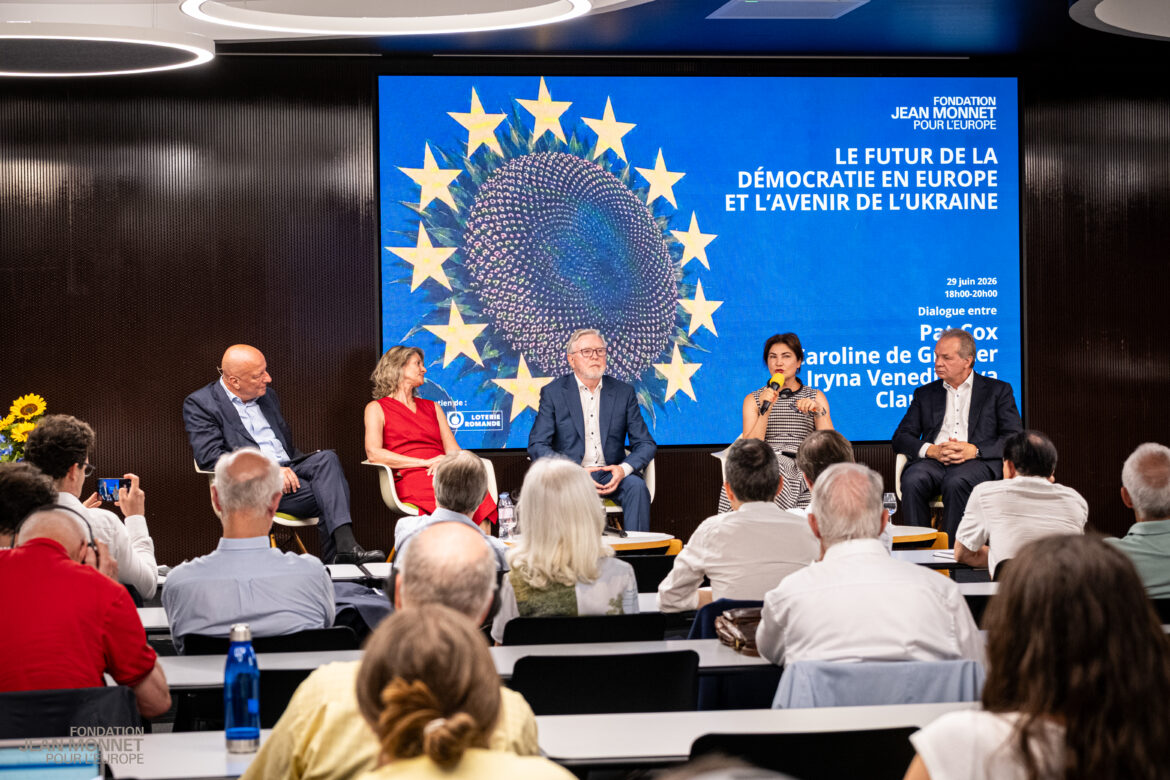
    [post_content] => On Monday 29 June 2026, the Jean Monnet Foundation for Europe organised a dialogue bringing together leading figures actively involved in European and Ukrainian issues. Watch the video of the event here.

This dialogue brought together leading figures, all of whom are deeply committed to the major debates shaping the future of Europe and Ukraine, and provided an opportunity to pay tribute to Pat Cox, the Foundation’s outgoing president

Speakers:
Pat Cox: outgoing President of the Jean Monnet Foundation for Europe and former President of the European Parliament
Caroline de Gruyter: journalist and writer
Iryna Venediktova: Ambassador of Ukraine to Switzerland
Claude Wild: former Permanent Representative of Switzerland to the OSCE and the Council of Europe, former Swiss Ambassador to Ukraine
This bilingual event, held in French and English, took place in the IDHEAP Aula. The evening began with speeches by Pat Cox and Iryna Venediktova, setting the tone for the discussions that followed. Caroline de Gruyter and Claude Wild then joined them on stage for the dialogue, moderated by Roger de Weck, in which they shared their expertise on the future of democracy in Europe and the future of Ukraine.
The large audience was able to ask questions, and the discussions continued over drinks.
Watch the dialogue:
With the support of the University of Lausanne and the Loterie Romande
[post_title] => The future of democracy in Europe and the future of Ukraine (2026)
[post_excerpt] =>
[post_status] => publish
[comment_status] => closed
[ping_status] => closed
[post_password] =>
[post_name] => the-future-of-democracy-in-europe-and-the-future-of-ukraine
[to_ping] =>
[pinged] =>
[post_modified] => 2026-07-06 12:34:42
[post_modified_gmt] => 2026-07-06 10:34:42
[post_content_filtered] =>
[post_parent] => 0
[guid] => https://jean-monnet.ch/?post_type=evenement&p=12464
[menu_order] => 0
[post_type] => evenement
[post_mime_type] =>
[comment_count] => 0
[filter] => raw
)
On Monday 29 June 2026, the Jean Monnet Foundation for Europe organised a dialogue bringing together leading figures actively involved in European and Ukrainian issues. Watch the video of the event here.
WP_Post Object
(
    [ID] => 12452
    [post_author] => 18
    [post_date] => 2026-05-28 12:33:14
    [post_date_gmt] => 2026-05-28 10:33:14
    [post_content] => The activity report 2025 is now available, in French, you can find all off our multiple activities inside.


2025 has been a rich year for our institution. We are very pleased to present our activity report, that shows the multiplicities of our actions. You can consult it by clicking here.
    [post_title] => Activity Report 2025 (in French only)
    [post_excerpt] =>
    [post_status] => publish
    [comment_status] => open
    [ping_status] => open
    [post_password] =>
    [post_name] => activity-report-2025-in-french-only
    [to_ping] =>
    [pinged] =>
    [post_modified] => 2026-05-28 12:34:11
    [post_modified_gmt] => 2026-05-28 10:34:11
    [post_content_filtered] =>
    [post_parent] => 0
    [guid] => https://jean-monnet.ch/?p=12452
    [menu_order] => 0
    [post_type] => post
    [post_mime_type] =>
    [comment_count] => 0
    [filter] => raw
)
The activity report 2025 is now available, in French, you can find all off our multiple activities inside.
WP_Post Object
(
    [ID] => 12407
    [post_author] => 18
    [post_date] => 2026-05-06 09:01:52
    [post_date_gmt] => 2026-05-06 07:01:52
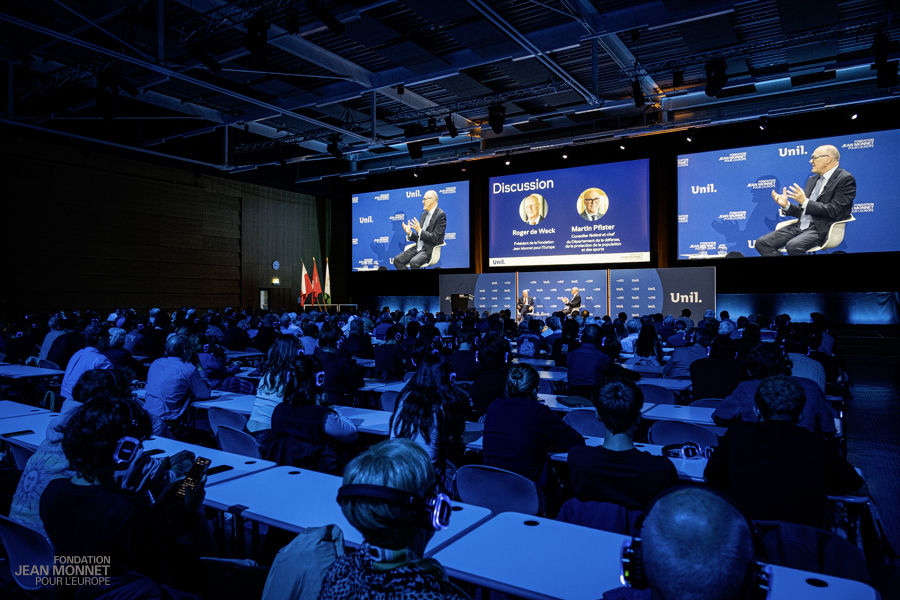
    [post_content] => On 6 May 2026, Martin Pfister, Federal Councillor and Head of the Department of Defence, Civil Protection and Sport, gave a lecture at the University of Lausanne. Watch the video of the event.

Security on the European continent has deteriorated significantly since Russia’s invasion of Ukraine. US policy towards Europe has become more uncertain. The cyber threat, as well as those posed by drones and long-range missiles, has become critical. Disinformation is rife. The European Union is developing its common defence policy. It is strengthening its strategic autonomy. The rearmament of the continent has accelerated. In this context, how can Switzerland’s security be ensured? What interests does it have in collaborating with its European neighbours? To what extent does its policy of neutrality protect it? How can it be prevented from becoming a "security gap" at the heart of the continent?

To answer these questions, the Jean Monnet Foundation for Europe, in collaboration with the University of Lausanne, hosted Federal Councillor and Head of the Department of Defence, Civil Protection and Sport, Martin Pfister.

The lecture took place at Unil-Amphimax. Following an opening address in French, Martin Pfister engaged in a discussion with Roger de Weck in German before answering questions from the large audience.

You can find the transcript of his speech (in French) here and the video of the event below. The discussion with Roger de Weck and the audience is in German, but YouTube allows you to add English subtitles.


With the support of the Loterie Romande
    [post_title] => Martin Pfister (2026)
    [post_excerpt] =>
    [post_status] => publish
    [comment_status] => closed
    [ping_status] => closed
    [post_password] =>
    [post_name] => martin-pfister-2026
    [to_ping] =>
    [pinged] =>
    [post_modified] => 2026-05-19 10:52:05
    [post_modified_gmt] => 2026-05-19 08:52:05
    [post_content_filtered] =>
    [post_parent] => 0
    [guid] => https://jean-monnet.ch/?post_type=evenement&p=12407
    [menu_order] => 1
    [post_type] => evenement
    [post_mime_type] =>
    [comment_count] => 0
    [filter] => raw
)
On 6 May 2026, Martin Pfister, Federal Councillor and Head of the Department of Defence, Civil Protection and Sport, gave a lecture at the University of Lausanne. Watch the video of the event.
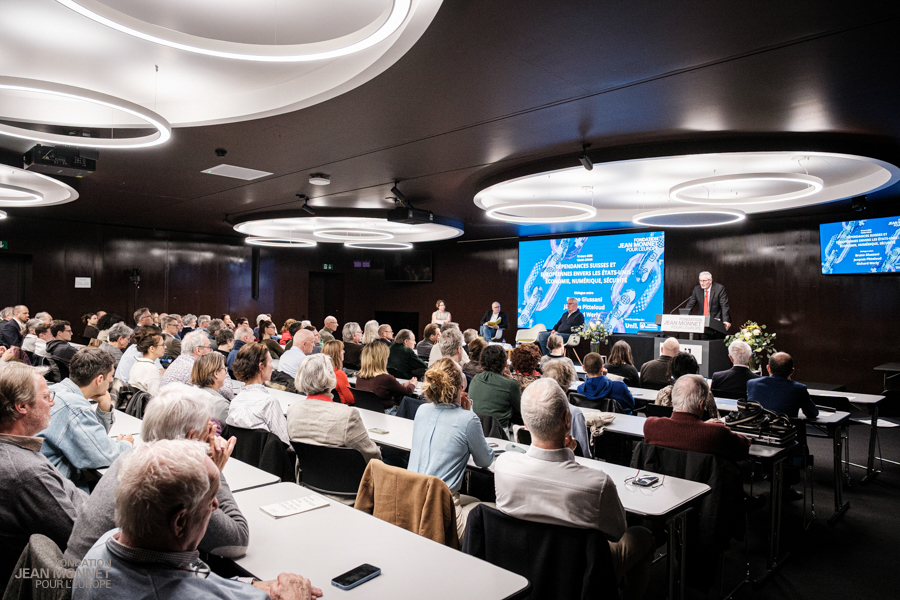
On Wednesday 18 March 2026, the Foundation organised a dialogue on Swiss and European dependencies on the United States. Watch the film here.
As economic protectionism resurfaces, digital tools dominate our daily lives, and geopolitical maps are being redrawn, the transatlantic relationship has never been more crucial—nor more unbalanced. Between strategic imperative and the need for autonomy, what room for manoeuvre truly remains for Switzerland and Europe in the face of the American giant?
To explore these challenges, we had the honour of welcoming three prominent Swiss figures who offered distinct analytical perspectives:
Bruno Giussani: author of "Moins d'Amérique dans nos vies" and "Manuel de résistance à l'emprise technologique", who provided insights into the technological and societal aspects.
Jacques Pitteloud: Swiss Ambassador to the Kingdom of Belgium and Head of the Swiss Mission to NATO, who shared his views on diplomacy and security
Richard Werly: journalist, author of "Cette Amérique qui nous déteste" and France/Europe correspondent for Blick, who provided a political and European analysis.
Together, they painted a stark picture: in the military, digital and economic spheres, Europe has gradually relinquished its ability to act independently. This dependence has been made more visible and more worrying than ever by Donald Trump’s policies.
The discussion took place in the IDHEAP auditorium and was moderated by Gwendoline Munsch, editor and co-president of HEConomist, before giving way to a lively exchange with a large audience.
Watch the film here:
With the support of the University of Lausanne and La Loterie Romande
[post_title] => Swiss and European Dependencies on the United States (2026)
[post_excerpt] =>
[post_status] => publish
[comment_status] => closed
[ping_status] => closed
[post_password] =>
[post_name] => swiss-and-european-dependencies-on-the-united-states-economy-digital-security
[to_ping] =>
[pinged] =>
[post_modified] => 2026-03-26 08:58:13
[post_modified_gmt] => 2026-03-26 07:58:13
[post_content_filtered] =>
[post_parent] => 0
[guid] => https://jean-monnet.ch/?post_type=evenement&p=11448
[menu_order] => 6
[post_type] => evenement
[post_mime_type] =>
[comment_count] => 0
[filter] => raw
)
On Wednesday 18 March 2026, the Foundation organised a dialogue on Swiss and European dependencies on the United States. Watch the film here.
WP_Post Object
(
    [ID] => 11580
    [post_author] => 18
    [post_date] => 2026-03-31 19:55:50
    [post_date_gmt] => 2026-03-31 17:55:50
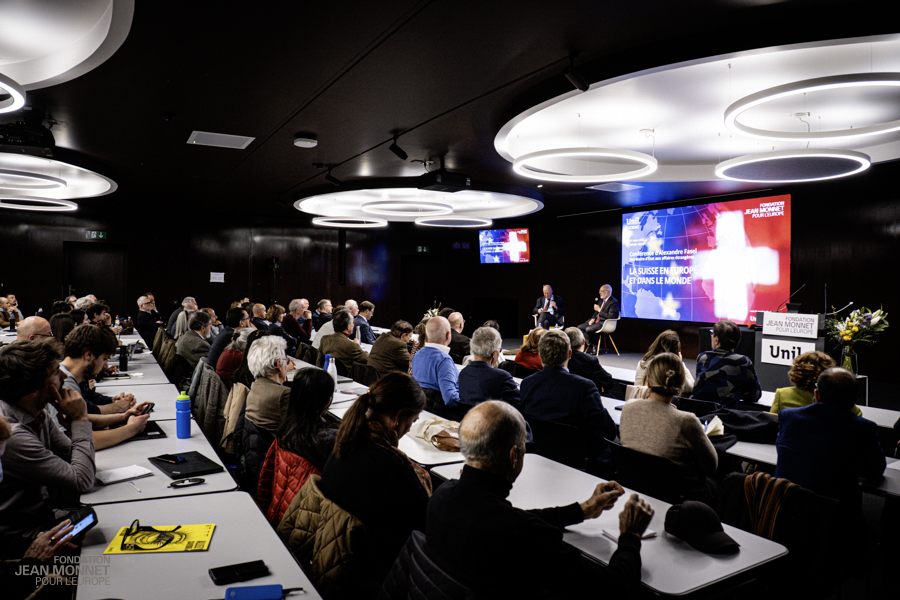
    [post_content] => On 31 March 2026, the Foundation and CEDIDAC welcomed the State Secretary for Foreign Affairs Alexandre Fasel, for a conference preceded by a screening of archive movie. Watch the film of the event.

To begin with, a video presentation produced in collaboration with the RTS Data & Archives department traced the major milestones in relations between Switzerland and Europe, from the post-war period to the conclusion of the Bilateral Agreements II. This retrospective provided the perfect backdrop to Alexandre Fasel’s lecture entitled "Switzerland in Europe and the World".

He then outlined the Federal Council’s vision for the future of Swiss-European relations. Drawing on personal archives dating back to 1991, he reiterated the constant of Swiss strategy: to participate in the European market, our true domestic market, in order to guarantee our prosperity. The rejection of the European Economic Area (EEA) in December 1992, described as a “black Sunday” for the economy, followed by the development of the Bilateral Agreements I and II, have shaped a unique path that Switzerland is now seeking to consolidate in the face of new geopolitical pressures, whilst preserving its sovereignty. Following the consultation process, the Bilateral Agreements III package is now before the Federal Assembly, before being put to a vote by the Swiss people.

The conference was held in the Aula-IDHEAP, where a large audience was present, and concluded with a discussion between Alexandre Fasel and the audience, moderated by Roger de Weck, before an aperitif brought the proceedings to a close.


Watch the film and the conference :


Film credits: Vincent Seriot, Head of Content RTS Archives; Salomé Breguet, Documentalist RTS Archives; Alexandre Billardo, Editor RTS Archives; Adelina Osdautaj, Project officer, FJME.

With the support of the University of Lausanne, La Loterie Romande and the Data & Archives department of RTS
    [post_title] => Alexandre Fasel (2026)
    [post_excerpt] =>
    [post_status] => publish
    [comment_status] => closed
    [ping_status] => closed
    [post_password] =>
    [post_name] => alexandre-fasel-2026
    [to_ping] =>
    [pinged] =>
    [post_modified] => 2026-04-15 11:22:35
    [post_modified_gmt] => 2026-04-15 09:22:35
    [post_content_filtered] =>
    [post_parent] => 0
    [guid] => https://jean-monnet.ch/?post_type=evenement&p=11580
    [menu_order] => 2
    [post_type] => evenement
    [post_mime_type] =>
    [comment_count] => 0
    [filter] => raw
)
On 31 March 2026, the Foundation and CEDIDAC welcomed the State Secretary for Foreign Affairs Alexandre Fasel, for a conference preceded by a screening of archive movie. Watch the film of the event.
Roger de Weck is the new President of the Foundation
WP_Post Object
(
[ID] => 11626
[post_author] => 18
[post_date] => 2026-03-01 07:44:52
[post_date_gmt] => 2026-03-01 06:44:52
[post_content] => Since 1 March 2026, Roger de Weck is the president of the Foundation.
After eleven years as president, Pat Cox decided to step down for family reasons.
On 24 February 2026, the Executive Board, the institution's decision-making body, appointed Mr Roger de Weck as the new president of the Foundation for a renewable three-year term, starting on 1 March 2026.
Born in Fribourg in 1953, Roger de Weck is a journalist, podcaster and bestselling author. A graduate of the University of St. Gallen (HSG) and holder of honorary doctorates from the University of Fribourg and the University of Lucerne, he is bilingual in French and German. He has worked for Swiss and foreign publications (24 heures, La Tribune de Genève, Die Zeit) before heading up the editorial teams of the Tages-Anzeiger and the German weekly Die Zeit. He chaired the Foundation Board of the Graduate Institute of International and Development Studies in Geneva from 2004 to 2010. He was Director General of the Swiss Broadcasting Corporation (SRG SSR) from 2011 to 2017. Currently a visiting professor at the College of Europe in Bruges, he is a member of the Council of the International Charlemagne Prize of Aachen.
Roger de Weck is the fifth president of the Foundation created by Jean Monnet in 1978, succeeding Henri Rieben (1978-2005), Bronislaw Geremek (2006-2008), José Maria Gil-Robles (2009-2014) and Pat Cox (2015-2026).
At its meeting on 24 February 2026, the Executive Council also appointed Fabien Fivaz and Laurent Wehrli as new members, effective 1 March 2026.
Press release of 24 February 2026 (only in French)Biography of Roger de Weck
[post_title] => Roger de Weck is the new President of the Foundation
[post_excerpt] =>
[post_status] => publish
[comment_status] => closed
[ping_status] => closed
[post_password] =>
[post_name] => roger-de-weck-is-the-new-president-of-the-foundation
[to_ping] =>
[pinged] =>
[post_modified] => 2026-03-01 10:25:22
[post_modified_gmt] => 2026-03-01 09:25:22
[post_content_filtered] =>
[post_parent] => 0
[guid] => https://jean-monnet.ch/?post_type=fondation&p=11626
[menu_order] => 0
[post_type] => fondation
[post_mime_type] =>
[comment_count] => 0
[filter] => raw
)
Since 1 March 2026, Roger de Weck is the president of the Foundation.
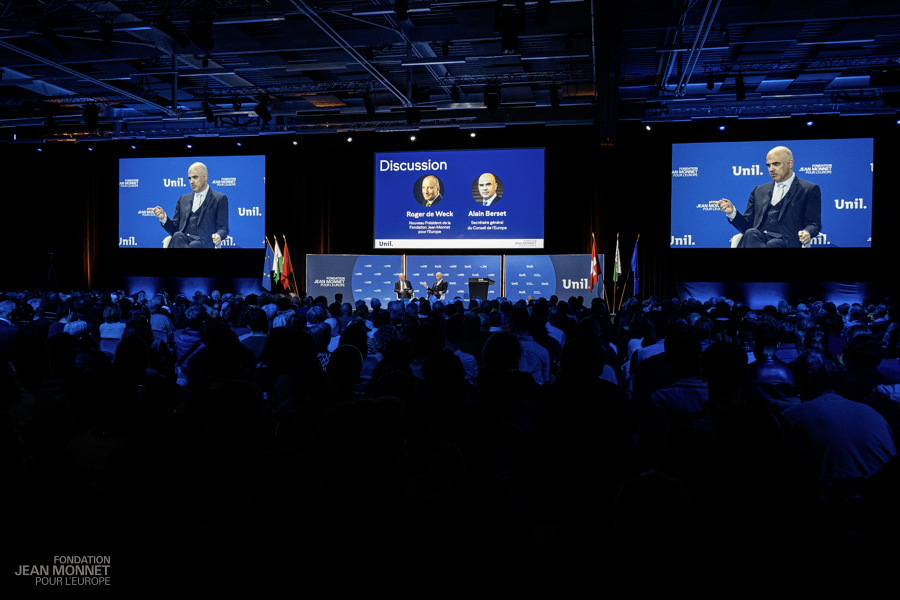
Watch the film of the lecture given by Alain Berset, Secretary General of the Council of Europe, during his visit to the University of Lausanne.
The Jean Monnet Foundation, in partnership with the University of Lausanne, welcomed Alain Berset, Secretary General of the Council of Europe, for a special conference on security and the preservation of the continent's democratic foundations.
After welcoming remarks by Frédéric Herman, Rector of the University of Lausanne, Jacques de Watteville, Vice-President of the Foundation, and Roger de Weck, the Foundation's new President and the moderator, Alain Berset spoke about the major changes in the world since 2008, marked by numerous crises that he described as creating a ‘perfect storm’. He warned that Europe could move from a system based on law to one where the most powerful impose their own rules.
Faced with rising tensions and rearmament, he defended the idea of democratic security. In his view, military force can only protect our freedoms if it is underpinned by strong institutions, such as independent courts and free media. He therefore called for investment in these institutions to be taken as seriously as investment in military defence.
In concrete terms, the Council of Europe is working on initiatives such as the Damage Register for Ukraine and agreements to combat disinformation in order to protect the integrity of elections.
Finally, he emphasised the importance of Switzerland's experience in dialogue and minority integration for resolving conflicts in Europe. He warned that Europe could shift from a rights-based system to one where the most powerful impose their will. He was optimistic, predicting that with effort, Europe could be stronger in ten years, provided it does not become accustomed to the unacceptable and holds to its values.
The conference continued with a discussion with Roger de Weck, followed by a Q&A session with the large audience.
The conference was held at Amphimax 350 and 351, to a capacity crowd, at the University of Lausanne.
Watch the lecture live below:
With the support of La Loterie Romande
[post_title] => Alain Berset (2026)
[post_excerpt] =>
[post_status] => publish
[comment_status] => closed
[ping_status] => closed
[post_password] =>
[post_name] => alain-berset-2026
[to_ping] =>
[pinged] =>
[post_modified] => 2026-03-03 10:41:26
[post_modified_gmt] => 2026-03-03 09:41:26
[post_content_filtered] =>
[post_parent] => 0
[guid] => https://jean-monnet.ch/?post_type=evenement&p=11442
[menu_order] => 3
[post_type] => evenement
[post_mime_type] =>
[comment_count] => 0
[filter] => raw
)
Watch the film of the lecture given by Alain Berset, Secretary General of the Council of Europe, during his visit to the University of Lausanne.
42nd issue of the Debates and Documents Collection
WP_Post Object
(
    [ID] => 11502
    [post_author] => 15
    [post_date] => 2026-02-02 16:32:19
    [post_date_gmt] => 2026-02-02 15:32:19
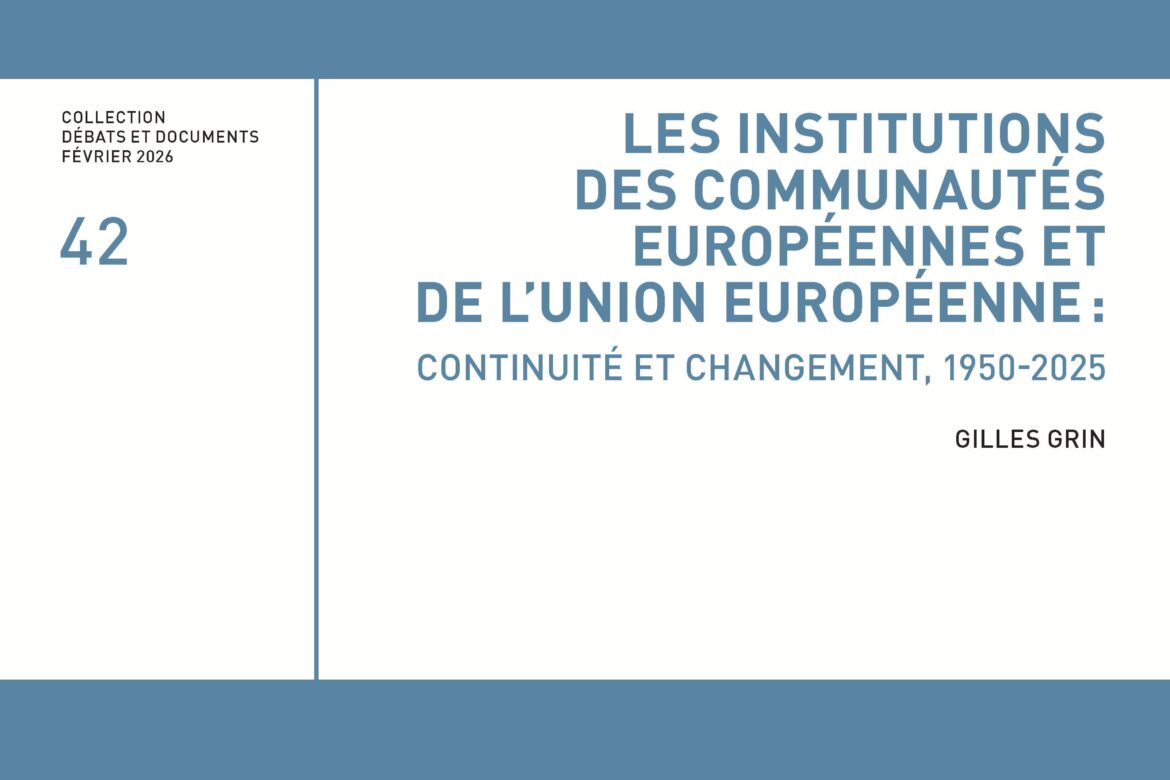
    [post_content] => The Foundation is pleased to announce the publication of the latest issue of its Debates and Documents Collection (issue 42), available in open access.


This issue is entitled ‘The Institutions of the European Communities and the European Union: Continuity and Change, 1950-2025’, written by Gilles Grin, Director of the Foundation. This is the French version of the book published in English in October 2025 (issue 40 of the aforementioned Collection). This book traces the history of the European institutions from 1950 to 2025. It shows how, throughout their history, they have been characterised by both continuity and change.

Read or download the publication
    [post_title] => 42nd issue of the Debates and Documents Collection
    [post_excerpt] =>
    [post_status] => publish
    [comment_status] => closed
    [ping_status] => closed
    [post_password] =>
    [post_name] => 41st-issue-of-the-debates-and-documents-collection-2
    [to_ping] =>
    [pinged] =>
    [post_modified] => 2026-02-03 14:15:58
    [post_modified_gmt] => 2026-02-03 13:15:58
    [post_content_filtered] =>
    [post_parent] => 0
    [guid] => https://jean-monnet.ch/?post_type=publication&p=11502
    [menu_order] => 0
    [post_type] => publication
    [post_mime_type] =>
    [comment_count] => 0
    [filter] => raw
)
The Foundation is pleased to announce the publication of the latest issue of its Debates and Documents Collection (issue 42), available in open access.
WP_Post Object
(
    [ID] => 11365
    [post_author] => 18
    [post_date] => 2025-11-10 11:05:44
    [post_date_gmt] => 2025-11-10 10:05:44
    [post_content] => The conference “Biographer of Statesmen: A Conversation with Éric Roussel”, member of the Institut de France (Académie des sciences morales et politiques), was held on Tuesday, 2 December 2025. You can watch the film of the event here.

This event, organised in partnership with the Cercle littéraire de Lausanne, took place on the latter's premises. The interview was led by Gilles Grin, Director of the Jean Monnet Foundation, and Guillaume Poisson, President of theCercle littéraire. The discussion allowed the audience to discover the working methods, as well as a few anecdotes, of a biographer specialising in statesmen. The evening concluded with questions from the large audience in attendance and an aperitif.

Writer and journalist, Éric Roussel is the author of several acclaimed biographies of major French statesmen of the 20th century : Georges Pompidou, bestseller in 1984; Jean Monnet, Académie française Essay Prize in 1996; Charles de Gaulle, Renaudot Poche Prize in 2020; Pierre Mendès France, Académie française Biography Prize in 2007); François Mitterrand, Montaigne Prize in 2016; and Valéry Giscard d’Estaing in 2018. Several of his works have been translated. Since 2018, Éric Roussel has been a member of the Institut de France.

Watch the conference below:


Explore Éric Roussel’s publications available at the Foundation’s library.

publications
    [post_title] => Éric Roussel (2025)
    [post_excerpt] =>
    [post_status] => publish
    [comment_status] => closed
    [ping_status] => closed
    [post_password] =>
    [post_name] => eric-roussel-2025
    [to_ping] =>
    [pinged] =>
    [post_modified] => 2025-12-08 14:37:37
    [post_modified_gmt] => 2025-12-08 13:37:37
    [post_content_filtered] =>
    [post_parent] => 0
    [guid] => https://jean-monnet.ch/?post_type=evenement&p=11365
    [menu_order] => 5
    [post_type] => evenement
    [post_mime_type] =>
    [comment_count] => 0
    [filter] => raw
)
The conference “Biographer of Statesmen: A Conversation with Éric Roussel”, member of the Institut de France (Académie des sciences morales et politiques), was held on Tuesday, 2 December 2025. You can watch the film of the event here.
The Foundation is an independent, non-partisan and non-militant institution of public utility, which operates from the Ferme de Dorigny, located at the heart of the University of Lausanne campus. It was created in 1978 by Jean Monnet, designer and first president of the first European Community (coal-steel) and first honorary citizen of Europe, who entrusted it with his entire archive. Today, it holds many other private archives which it promotes.
It offers researchers a coherent set of unique documentary resources on the origins and developments of European integration and Swiss-European relations. It also contributes to the training of students, while an editorial mission completes the range of its activities with two collections of publications. The Foundation, which welcomes visitors by appointment and regularly organises conferences, debates and symposia, has become a European crossroads and an essential place for meetings, debates and reflection on major current European issues. It is supported by the Swiss Confederation, the Canton of Vaud, the City of Lausanne and the University of Lausanne.
Since 2005, the Foundation has been digitising its archives to allow easy access and consultation by researchers from all over the world. Since the end of 2021, these documents as well as the archive inventories are accessible on the web via a web portal developed by the Foundation.